Learn what useful TBI rehabilitation documentation should show treatment teams, case managers and legal professionals on MVA files. Progress after traumatic brain injury is rarely a straight line. A client may complete a task independently one day and require substantial prompting the next. Fatigue, pain, sleep, mood, sensory load, environment, and task complexity can all …
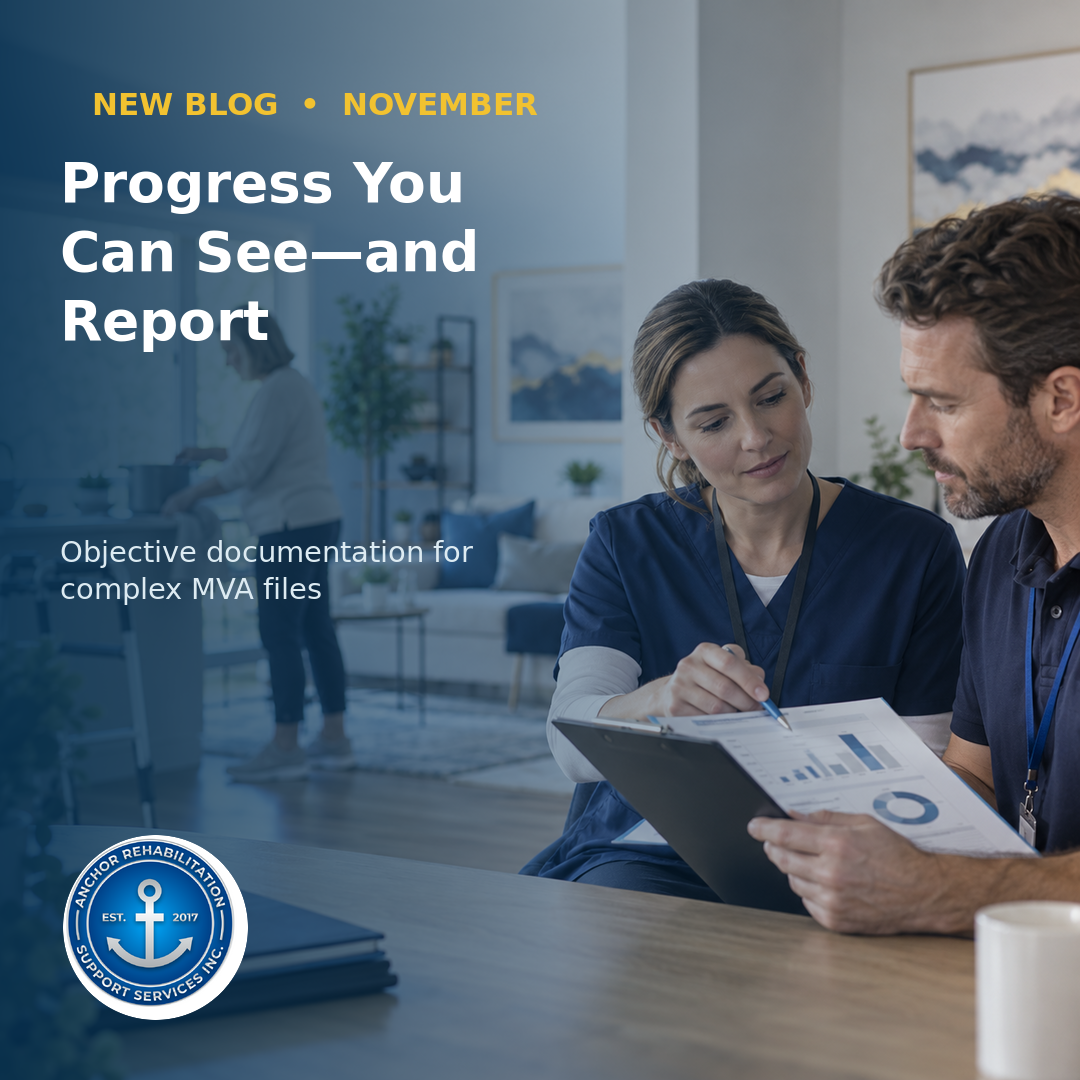
Learn what useful TBI rehabilitation documentation should show treatment teams, case managers and legal professionals on MVA files.
Progress after traumatic brain injury is rarely a straight line. A client may complete a task independently one day and require substantial prompting the next. Fatigue, pain, sleep, mood, sensory load, environment, and task complexity can all influence performance.
For occupational therapists, case managers, legal professionals, insurers, and families, a simple statement that a session “went well” does not provide enough information. Useful documentation should connect everyday rehabilitation work to the goals, supports, barriers, and functional changes that matter to the file.
What objective rehabilitation documentation can capture
Objective does not mean cold or impersonal. It means describing what occurred in observable, specific language. Depending on the client’s plan, documentation may include:
- the task or setting;
- the goal being addressed;
- the type and frequency of prompts required;
- the level of assistance or supervision;
- environmental factors that affected performance;
- strategies used and the client’s response;
- safety concerns or barriers;
- measurable changes over time; and
- information that should be communicated to the treatment team.
The most useful notes explain function. “Client completed grocery shopping” tells only part of the story. Did the client create a list, locate items, manage distractions, compare prices, remain within budget, navigate the store safely, and recover when an item was unavailable? What support was needed?
Why context matters after TBI
A score or frequency count without context can be misleading. If a client needed fewer prompts because the task was simplified, the environment was quieter, or a caregiver completed several steps, the apparent improvement may not reflect increased independence.
Likewise, a difficult session may offer important clinical information. Increased fatigue in a crowded environment, difficulty shifting plans, or escalation following an unexpected change can help the team identify patterns and adjust supports.
Documentation should support—not replace—clinical judgment
Data can help identify trends, but numbers do not interpret themselves. Regulated professionals remain responsible for clinical assessment and treatment decisions within their scopes of practice. The RTA’s role is to implement the directed plan, observe performance, and communicate relevant information accurately.
When behaviour needs are part of the file, a Registered Behaviour Analyst may help define observable targets, examine patterns, develop Behaviour Support Plans, and review data over time. This can strengthen consistency between behavioural recommendations and day-to-day implementation.
Better communication across the circle of care
Complex MVA files can include many professionals. Timely, customized reporting helps reduce fragmented care by showing whether strategies are being used consistently and whether the client is progressing toward functional goals.
Clear documentation may help the team:
- prepare for case conferences;
- refine rehabilitation goals;
- identify when an approach needs adjustment;
- understand support needs across different environments;
- communicate functional changes to legal and insurance stakeholders; and
- preserve continuity when team members or routines change.
Documentation must also respect privacy, consent, professional boundaries, and the intended audience. More information is not always better; relevant information is better.
Questions referral partners can ask
When selecting an implementation provider, consider asking how goals are translated into session plans; how prompting and assistance are documented; how concerns are escalated; how reports are customized for the treatment team; and how behavioural and rehabilitation services coordinate when both are involved.
Anchor Rehabilitation Support Services was built for files that require structure, accountability, and collaboration. Our integrated model combines clinical behavioural oversight with in-environment implementation, along with documentation designed to support coordinated clinical, legal, and insurance communication.
Discuss a complex MVA referral
If a client requires consistent implementation, real-world observation, and accountable communication across the treatment team, Anchor can help determine whether RTA or behaviour consultation services may fit the rehabilitation plan.
Discuss a client referral: https://tinyurl.com/AnchorFreeConsult.